“We believe that a sustainable healthcare system relies on uplifting every clinician to their full scope of practice. We advocate for the recognition and integration of community paramedics, nurses, and allied health professionals as autonomous, vital pillars of primary care—moving away from outdated hierarchies to build a system where diverse clinical mastery is celebrated and utilised.”
Nicole Foster, Director
What is Community Paramedicine?
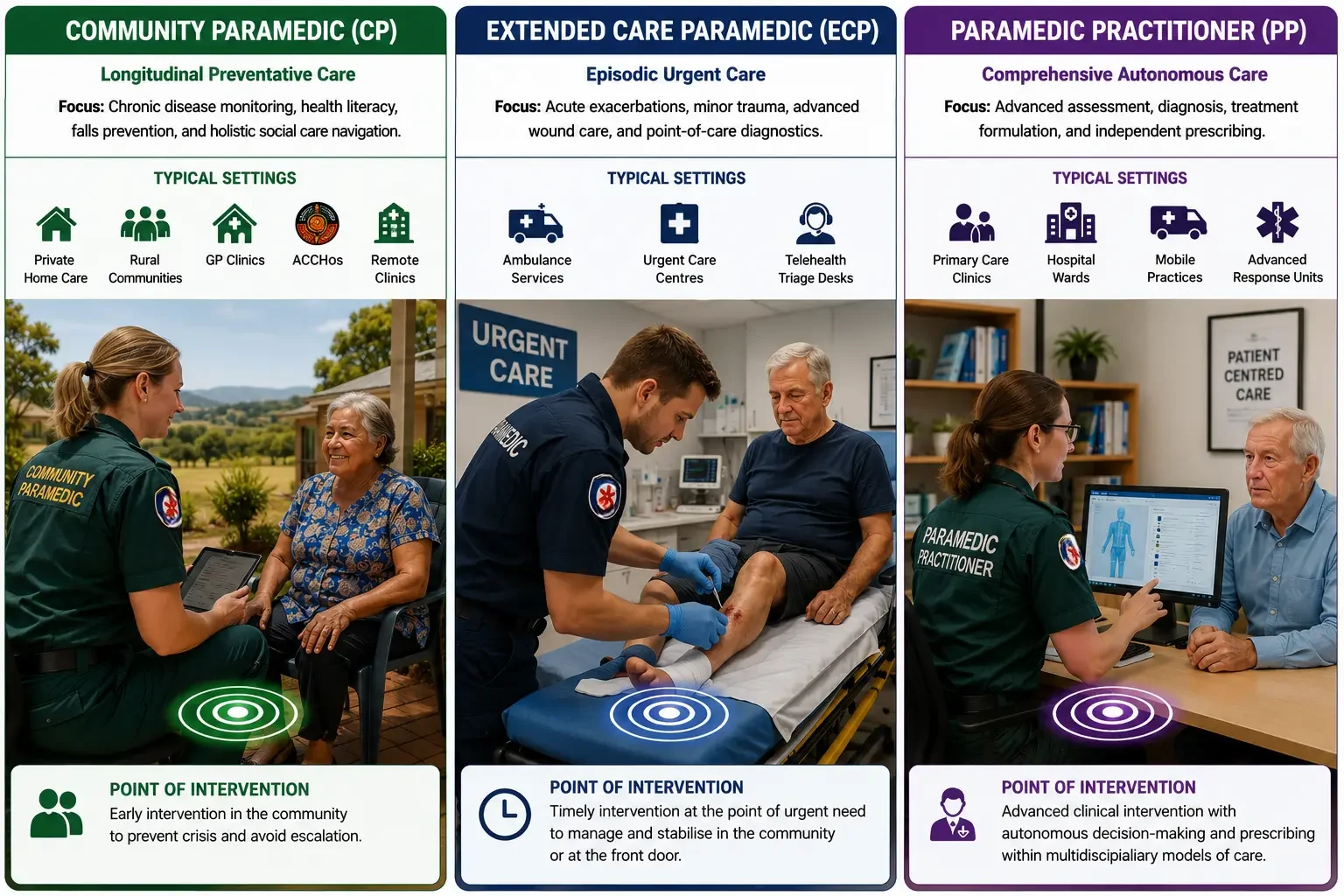
Community Paramedicine (CP) establishes a sophisticated, person-centred framework that ensures professional healthcare is accessible across all demographics. By leveraging situated practice, the model delivers high-quality clinical care in non-traditional settings tailored to the local community's unique needs and social determinants. CP program implementation should be guided by a community needs assessment and tailored to address population needs, social determinants of health, and local health service gaps. Programs can include primary health care, urgent care, health promotion, disease management, and needs-based care. Community paramedicine programs should be co-designed and integrated into interdisciplinary healthcare services to improve patient outcomes through education, advocacy, and health system navigation. Proactive community intervention will affect the number of acute presentations to hospitals. These outcomes have been documented in international community paramedicine programs for over two decades. Significant advancements in paramedic education, an expanded clinical scope, and improved clinical governance frameworks have led to the profession being increasingly recognised as a valuable contributor to the patient’s journey across the healthcare continuum and industry sectors.
What is a Community Paramedic?
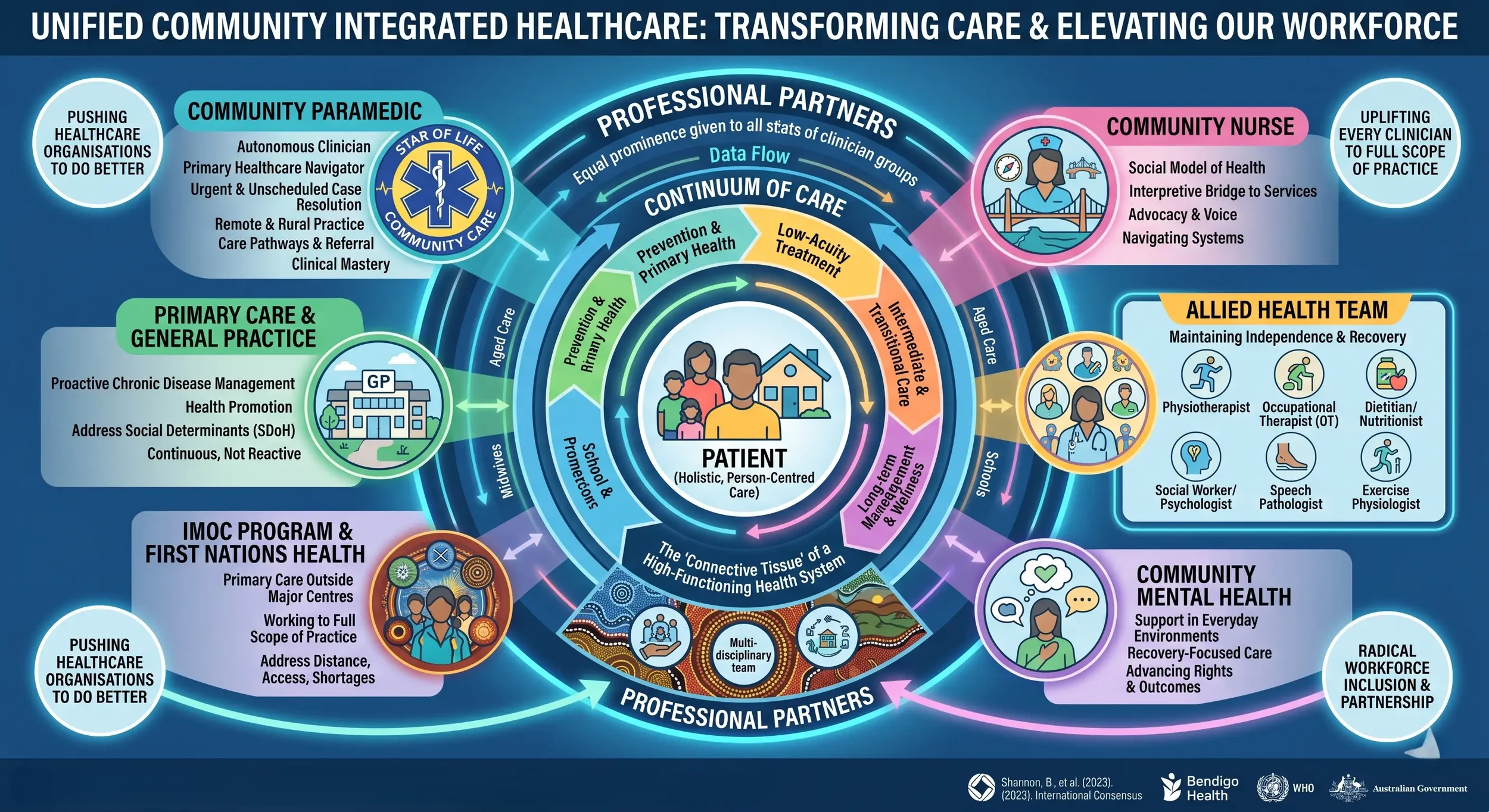
Community Paramedics are autonomous clinicians skilled in primary healthcare navigation, complex care management, and non-urgent clinical procedures. In partnership with General Practitioners, physicians, and interdisciplinary services, they provide holistic, person-centred care to keep patients well within their communities. By bridging critical access gaps, they support individuals at their most vulnerable points in the healthcare journey. A Continuum of Care Community Paramedics support patients across the entire care spectrum, from preventative and primary healthcare strategies to low-acuity treatments. They operate within integrated teams to provide intermediate, transitional, and emergency care, ensuring patients remain connected to the most appropriate care pathways.
Core Capabilities
Community Paramedics are equipped with advanced clinical competencies designed for autonomous practice in non-traditional settings:
Clinical Mastery: Advanced knowledge in physical examination, pharmacology, and pathophysiology.
Critical Reasoning: Enhanced clinical decision-making and diagnostic synthesis
Specialised Interventions: Proficiency in non-urgent clinical procedures and assessment tools.
Pathways & Referral: Expertise in alternative care pathways to connect patients with primary healthcare, palliative, social, and virtual care services.
Definition
To ensure international consistency, Frontier Health Solutions adopts the following peer-reviewed consensus definition:
"A community paramedic provides person-centred care in a diverse range of settings that address the needs of the community.
Their practice may include provision of primary health care, health promotion, disease management, clinical assessment and needs-based interventions.
They should be integrated with interdisciplinary health care teams, which aim to improve patient outcomes through education, advocacy, and health system navigation."
— Shannon, B., et al. (2023). The definition of a community paramedic: An international consensus. Paramedicine. https://journals.sagepub.com/doi/10.1177/27536386221148993
Where are Community Paramedics working?
Community Paramedicine functions as the definitive clinical intermediary, providing the systemic architecture necessary to synchronise episodic acute response with longitudinal primary care. As the 'connective tissue' of a high-functioning health system, these standards are operationalised across six core clinical domains.
PRIMARY CARE & GENERAL PRACTICE
This domain prioritises the proactive management of chronic disease trajectories and the systematic delivery of health promotion and preventative screening. It moves beyond episodic care to address the Social Determinants of Health (SDoH) that drive long-term morbidity. By embedding the practitioner within the primary care team, the focus is on biopsychosocial stabilisation, ensuring that health maintenance is continuous rather than reactive, thereby reducing the burden on acute systems.
URGENT & UNSCHEDULED CARE
This domain prioritises the on-site resolution of undifferentiated acute illnesses and minor injuries within the home, community clinics, or via specialised ambulance-led low-acuity response units. It focuses on mitigating avoidable Emergency Department (ED) presentations by providing definitive, high-quality care at the point of need. By shifting the clinical focus away from the acute hospital, the practitioner, whether operating from a stationary hub or a mobile response vehicle, ensures system-wide resource optimisation while maintaining patient safety through evidence-based risk stratification.
POST-ACUTE REHABILITATION, TRANSITIONAL CARE & HOSPITAL-AT-HOME
CPs in this domain facilitate the seamless transition of high-risk complex patients from acute inpatient settings to the community. This domain prioritises reducing unplanned readmissions by addressing the "post-hospital syndrome"—a period of transient vulnerability. It focuses on enhancing patient self-efficacy and health literacy to ensure long-term stability in the home environment.
FIRST NATIONS AND VULNERABLE POPULATIONS
CP’s in this domain target the Social Determinants of Indigenous Health by integrating mental health, addiction, and social care through a culturally safe lens. It acknowledges that for First Nations peoples, health is a holistic concept encompassing the physical, social, emotional, spiritual, and cultural well-being of the entire community.
REMOTE, RURAL & AUSTERE SETTINGS
This domain prioritises a dual-competency model, integrating the rapid stabilisation skills of acute care with the comprehensive, longitudinal management strategies of primary health. By operating at the interface of unscheduled and scheduled care, the practitioner minimises system fragmentation. This approach ensures that patients receive definitive intervention for acute episodes while simultaneously addressing underlying chronic comorbidities and health maintenance requirements within a single clinical encounter.
INDUSTRIAL AND OCCUPATIONAL HEALTH
This domain addresses the delivery of healthcare within high-consequence industrial environments, including remote mining, offshore energy, and corporate sectors. It prioritises a dual-objective model: the immediate stabilisation of occupational trauma (Acute) and the longitudinal management of workforce wellness (Primary). By integrating health surveillance and injury prevention into the clinical workflow, the practitioner minimises "Lost Time Injuries" (LTI) and ensures the physiological readiness of the workforce in isolated setting.
What is Primary Care?
Primary health care is any medical service provided outside the four walls of a hospital, including aged care, community health, general practice, custodial care, schools, and many other primary health care settings. (Australian Primary Health Care Nurses Association).
What is Community Integrated Healthcare?
Community Integrated Healthcare is a holistic, patient-centred model that unifies physical, mental, and social care services under one umbrella within a local area. It bridges the gap between fragmented systems, allowing doctors, allied health professionals, and social workers to collaborate seamlessly (Mukumbang FC, De Souza D, Liu H, Uribe G, Moore C, Fotheringham P, et al.).
What is the Innovative Models of Care Program (IMOC)?
A multidisciplinary team may be made up of a range of health workforce professions working to their full scope of practice, which may include, but are not limited to, medical practitioners, Aboriginal and Torres Strait Islander Health Workers and Practitioners, nurses, nurse practitioners, midwives, allied health practitioners, non-dispensing pharmacists, and/or other health professionals. The IMOC Program will help us find effective ways to deliver primary health care to people living outside major centres, addressing distance and access issues as well as workforce shortages. (Australian Government).
Who are Community Clinicians?
Community clinicians are healthcare and mental health professionals who treat patients in community settings—such as homes, schools, and local clinics—rather than in hospitals. They aim to provide accessible, person-centred care and improve overall community well-being (National Safety and Quality).
What is Community Nursing?
Nurses in community health provide an interpretative bridge between the acute sector and community services. They embrace a social model of health to advocate and give a voice to the community accessing care. In a system that is often complex and hard to navigate, nurses in community health can simplify health systems, referral pathways, and access to care (Australian Primary Health Care Nurses Association).
The Systems and Models of Care
What is Community Mental Health?
Community-based mental health care brings services closer to where people live, work, study and connect. It reduces isolation and supports recovery in everyday environments. But it is more than a compassionate alternative to institution-based care – it is the evidence-based model for expanding access to care, advancing rights and improving health and social outcomes (World Health Organisation).
What is Community Allied Health
Community Allied Health refers to healthcare services provided in local, non-hospital settings—like your home, local clinics, or aged-care facilities. It focuses on helping people recover from injuries, manage chronic conditions, and maintain independence so they can continue living safely in their own communities. (Bendigo Health).
Services are typically delivered by a team of Allied Health Professionals (AHPs). Instead of a hospital-based recovery model, these professionals focus on long-term management, rehabilitation, and lifestyle support. A community allied health team usually consists of:
Physiotherapists: To help with mobility, balance, strength, and pain relief.
Occupational Therapists (OTs): To assist with daily living tasks, home modifications, and assistive technology.
Speech Pathologists: For help with communication and swallowing.
Dietitians & Nutritionists: To manage diets and nutritional health.
Podiatrists: To assist with foot care and foot-related health issues.
Exercise Physiologists: To design safe physical fitness programs.
Social Workers & Psychologists: To provide counselling and mental health support (West Gippsland Healthcare Group).